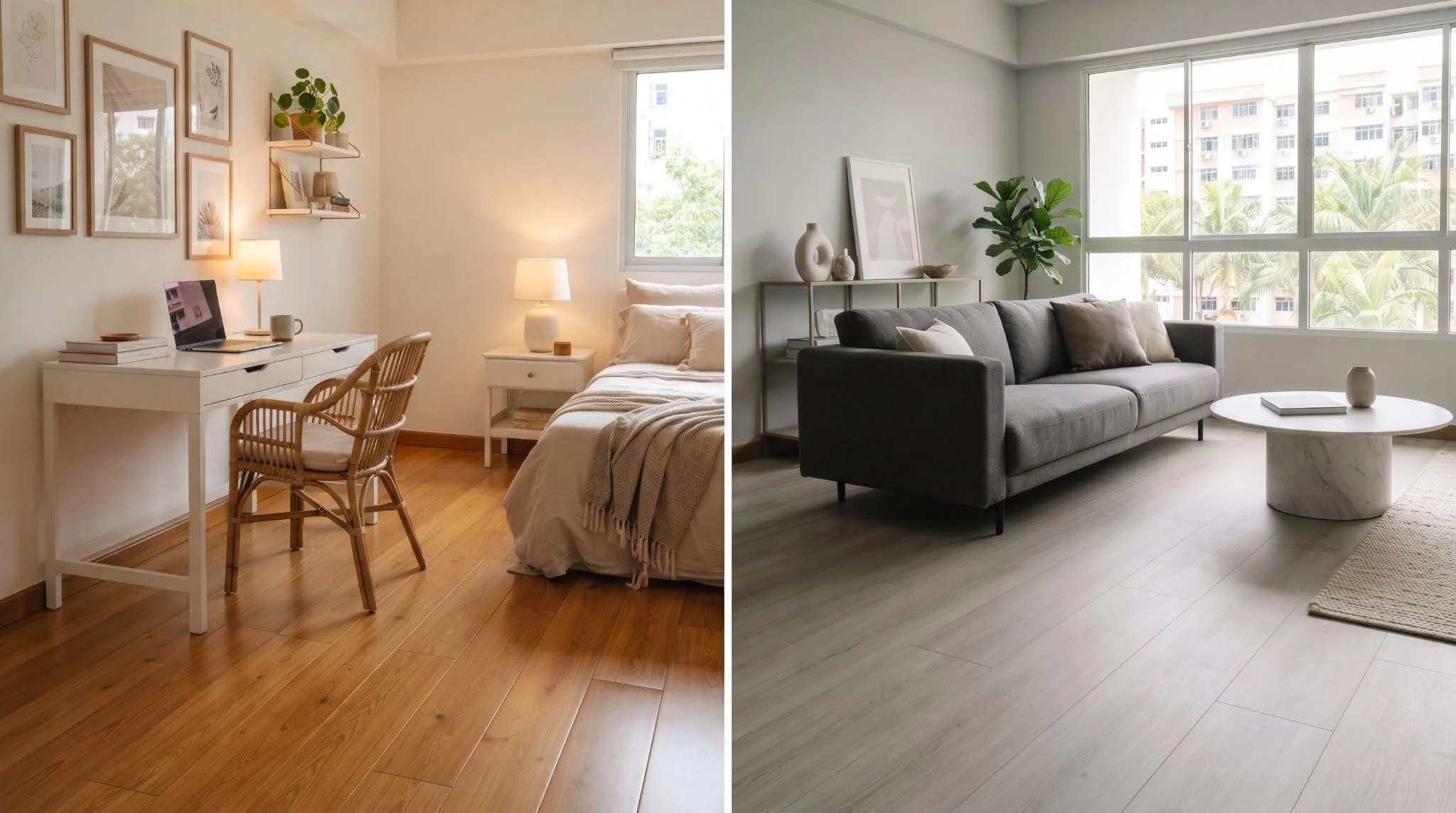
For most Singapore homes, vinyl flooring is the better choice. It resists water and humidity, handles spills in kitchens and service yards, feels quieter underfoot, and can often be installed over existing tiles without hacking. Laminate still has its place. It offers a hard, scratch-resistant surface and a convincing timber look at a competitive price. However, its fibreboard core can swell when exposed to moisture, which makes it a riskier choice in a humid, tropical climate. The right option depends on the room, your household, and how much moisture the floor will face.
Laminate and vinyl are two of the most popular flooring choices for HDB flats, condominiums and landed homes across Singapore. Both are more affordable than solid timber. Both come in realistic wood, stone and concrete finishes. Both can be installed quickly, which matters when you are working to a tight renovation timeline.
From a distance, the two can look almost identical. Underneath, they are built very differently, and that difference decides how each floor performs over the years. Below, we compare laminate and vinyl flooring side by side so you can choose the right option for your home.
What Is the Difference Between Laminate and Vinyl Flooring?
The key difference lies in the core material.
Laminate flooring uses a high-density fibreboard (HDF) core made from compressed wood fibres. A printed design layer sits on top, protected by a hard, clear wear layer. Because the core is wood-based, laminate can absorb moisture through its joints and edges.
Vinyl flooring is made from PVC-based materials. Modern options include Luxury Vinyl Tile (LVT) and Stone Plastic Composite (SPC), which has a rigid stone-polymer core. Vinyl does not absorb water the way a wood-based core does, so it stays stable in humid conditions.
This single difference affects water resistance, comfort, noise, maintenance and where each floor can be used in your home.
Laminate vs Vinyl Flooring: A Side-by-Side Comparison
| Factor | Laminate Flooring | Vinyl Flooring |
| Core material | Wood-based fibreboard (HDF) | PVC or stone-polymer (SPC) |
| Water resistance | Low to moderate; can swell if wet | High; suitable for kitchens and wet-prone areas |
| Humidity tolerance | Sensitive to prolonged humidity | Stable in Singapore’s climate |
| Scratch resistance | Very good | Good to very good, depending on wear layer |
| Noise underfoot | Can sound hollow or “clicky” | Quieter, especially with acoustic underlay |
| Comfort | Firm | Slightly softer and warmer underfoot |
| Installation over tiles | Possible | Possible; a popular no-hacking option |
| Maintenance | Dry or lightly damp cleaning only | Easy to mop and wipe |
| Repairs | Swollen planks must be replaced | Individual planks can be replaced |
| Cost | Entry-level options can be slightly cheaper | Similar price; fewer repairs over time in humid conditions |
What This Means for Singapore Homes
The biggest difference is how each floor handles water and humidity. Vinyl lets you wipe up spills without worry and stays stable in Singapore’s damp climate. Laminate’s fibreboard core can swell if water reaches the joints, so it is best kept to dry, air-conditioned rooms such as bedrooms and studies. For kitchens, service yards and areas near bathrooms, vinyl is the safer choice.
Laminate’s main advantage is its hard, scratch-resistant surface. Vinyl can match it when you choose a product with a thicker wear layer, which is worth checking in homes with children or pets.
Noise is the other deciding factor in apartment living. Vinyl is quieter underfoot, especially with an attached acoustic underlay, which makes a real difference in HDB flats and condos. Specialists such as Xin Furnishing, which supplies and installs vinyl flooring in Singapore, can recommend products with built-in underlay for homes where noise is a priority.
Conclusion
Laminate and vinyl flooring both offer an affordable way to achieve a stylish timber or stone look. Laminate provides a hard, scratch-resistant surface and works well in dry, air-conditioned spaces. Vinyl flooring offers better water resistance, humidity stability, quieter performance, and easier maintenance.
For most Singapore homes, those qualities make vinyl the more practical long-term choice. By considering how each room is used and carefully comparing product specifications, you can choose a floor that looks good and performs well for years.
Need Help Choosing Flooring for Your Home?
If you’re weighing up vinyl flooring for your HDB flat, condo or landed home, Xin Furnishing can assess your existing floor, recommend suitable products for each room and provide a quotation.
Xin Furnishing (Singapore)
🌐 Website: https://xinfurnishing.sg/
📞 Phone: +65 9376 6998 | +65 9690 2060
📍 Location: 101 Woodlands Avenue 12, #04-32, Singapore 737719
Frequently Asked Questions
Is vinyl flooring better than laminate in Singapore?
For most Singapore homes, yes. Vinyl handles water and humidity better, is quieter underfoot and is easier to clean. Laminate remains a good option for dry, air-conditioned rooms.
Can laminate flooring be used in the kitchen?
It is not recommended. Regular spills and mopping can cause laminate to swell at the joints. Vinyl is a more reliable choice for kitchens.
Can vinyl flooring be installed over existing tiles?
Yes, in most cases. As long as the tiles are firm and reasonably level, you can install vinyl directly over them without hacking.
Which is more scratch-resistant, laminate or vinyl?
Laminate generally has a harder surface. However, vinyl with a thick wear layer offers strong scratch resistance and suits homes with pets and children.